Search This Blog

Tuesday, January 21, 2014

Making Soy Milk

We're down to milking only one goat, Nigella, and the milk supply is noticeably meaner. At this time of dearth, I naturally start considering my options and they're limited: forgo milk or buy milk at the store. Neither is very appealing. Those of you home dairy enthusiasts out there know what I mean--store-bought milk doesn't have the 'fresh' taste we're used to, it tastes bland and dead, and it's a flavor most of us have gotten used to because the alternative takes a whole lot of work! 

So this is the season my soy milk maker reappears. Freshly made soy milk just doesn't compare to the soy milk available at the store in the same way fresh milk cannot compare with store-bought milk. Soy milk costs next to nothing to make at home. Dried soy beans are available at Asian food markets around town at about $2.99 for 2.5lbs. My soy milk maker produces about 6 cups / 1.5 quarts / 1.4 liters of soy milk in each batch and uses 1/2 cup dried beans per batch weighing in at about 1/4 lb. 3.75 gallons of soy milk, made at home, will cost only $2.99! Even better, you control all the inputs: no artificial flavoring, sugar, preservatives . . . need I say more? Here's a little tutorial to help you get started. If you don't have a soy milk maker, you'll need to use your blender and then gently boil the slurry for a predetermined amount of time but everything else remains the same--the soy milk maker is definitely worth it!


Start with dry beans

Add water and allow to soak overnight or 8 hours

Drain the beans after soaking

Fill soy milk maker bean receptacle with the soaked beans

Fill pitcher to fill line with water and add the beans

Press start and wait about 20 minutes

Finished soy milk!

This is the ground mash called 'Okara'. Okara should be scooped into cheesecloth and pressed as it contains quite a bit of rich soy milk

Strain the soy milk through a cheesecloth

Add the Okara to the cheesecloth and press, and press, and press until you've released all the soy milk

Here's the Okara after pressing, it takes on the shape and impressions of the cheesecloth and your hand

Break up the Okara to help it dry uniformly. At this point you can follow a recipe for turning it into soup, granola, fritters, the list goes on and on. You can even feed it to your livestock. I often give it to my dairy goats as Okara helps encourage milk production in dairy animals.

You can add any flavoring you like (or not!), my favorite is almond extract. I add 2 teaspoons per batch as it gives a delicate fragrance and pleasant flavor. I find no need to add sugar after adding the almond extract--though sometimes I do add some honey. 

Hot, freshly made soy milk flavored with almond extract and a spoonful of honey is a treat  on a cold winter day! I always keep some soybeans soaking in the refrigerator so that I can make a fresh batch the moment I run out. Enjoy!


Tuesday, June 11, 2013

Garlic Scape Pesto!


Garlic Scapes

June is the month for garlic scapes, the flowering stalk and immature flower head of the garlic plant. Garlic scapes taste very much like garlic cloves but are a little less intense. 

Following is a recipe for garlic scape pesto adapted from epicurious.com  from Ian Knauer's book The Farm :

This recipe makes about 1 1/2 cups of pesto which can be mixed with pasta, rice, quinoa or spread on little toasts or crackers.

Needed:
10 garlic scapes
1/3 cup unsalted pistachios (you can use any nut/seed here, we used sunflower seeds)
1/3 cup finely grated Parmigiano-Reggiano
Salt and Pepper to taste
1/3 cup extra-virgin olive oil

Reserve the oil, salt and pepper. Puree all the other ingredients in a food processor or blender (it helps to chop the scapes before putting them in). With the motor running, slowly begin pouring the oil through the opening and continue until you've poured in all the oil. The mixture will be fairly thick when you're finished. Salt and pepper to taste. The pesto will keep for a week in the fridge or frozen for a month.

To use, prepare a batch of pasta, rice, quinoa etc. and mix the pesto in to taste. Alternatively it can be used as a spread. Delicious!

Saturday, June 1, 2013

Sorrel Omelet and Puree of Sorrel and Potatoes


Herb - Sorrel


We love adding sorrel to our scrambled eggs and omelets. Anton grew up eating sorrel thanks to his French mother as it's widely eaten in France as a traditional spring green. Sorrel is sometimes called sour grass and we think you'll find it to have a refreshing flavor. We saute' the sorrel in melted butter and add it to the eggs which are best when just set. You can add anything you want to them. Avocado, sorrel, or crab meat are our favorites.

Here's a recipe for Sorrel Omelet/Scrambled Eggs:

Sorrel omelet:

Start by slicing your sorrel into thin slivers, use the stems too, just discard the very ends.
Take out the frying pan you'll use for the omelet and melt 1teaspoon to 1tablespoon butter (to your taste) and add salt and pepper to your taste.
When the butter is melted, add the sorrel and stir it into the butter. It will wilt and turn an unpleasant green color--this is normal!
Once all the sorrel has changed color (about 10-20 seconds) put it aside into a bowl.
Mix up your favorite omelet recipe and add to the same frying pan the sorrel was cooked in.
After the egg mixture is in the pan, spread the sorrel evenly on top by dropping it in by spoonfuls over the cooking omelet.

Puree of Sorrel and Potatoes
from: The Norman Table by Claude Guermont

This is another one of our favorite ways to eat sorrel.

Serves 2-3
3 tablespoons butter
1 bunch sorrel coarsely chopped
1/4 cup sliced onions
2 cups
3/4 cups potatoes, washed peeled, and coarsely chopped
Salt and pepper

1. Melt the butter in a heavy saucepan (the same one you'll use to cook the soup). Add the chopped sorrel leaves and cook until they turn dark green.
2. Add the sliced onions and cook for 2-3 minutes, stirring well.
3. Pour in the stock and bring to a boil. Add the chopped potatoes , cover, and simmer for approximately 30-40 minutes (until everything is tender).
4. Remove the soup from the heat and puree in a blender, food mill, or food processor.
5. Season to taste with salt and pepper.

Monday, May 27, 2013

Shots of the Market Garden

The market garden is off to a nice start this year. The focus has been on putting transplants in the ground so naturally the weeds aren't getting the attention they deserve, but we're farther ahead on weeding this year than years past. This is my last week of teaching so starting Saturday I'll have many more hours in the day to dedicate to those pesky weeds--watch out!
Transplants ready for the garden . . .


. . . more transplants ready for the garden!

A freshly weeded row of garlic

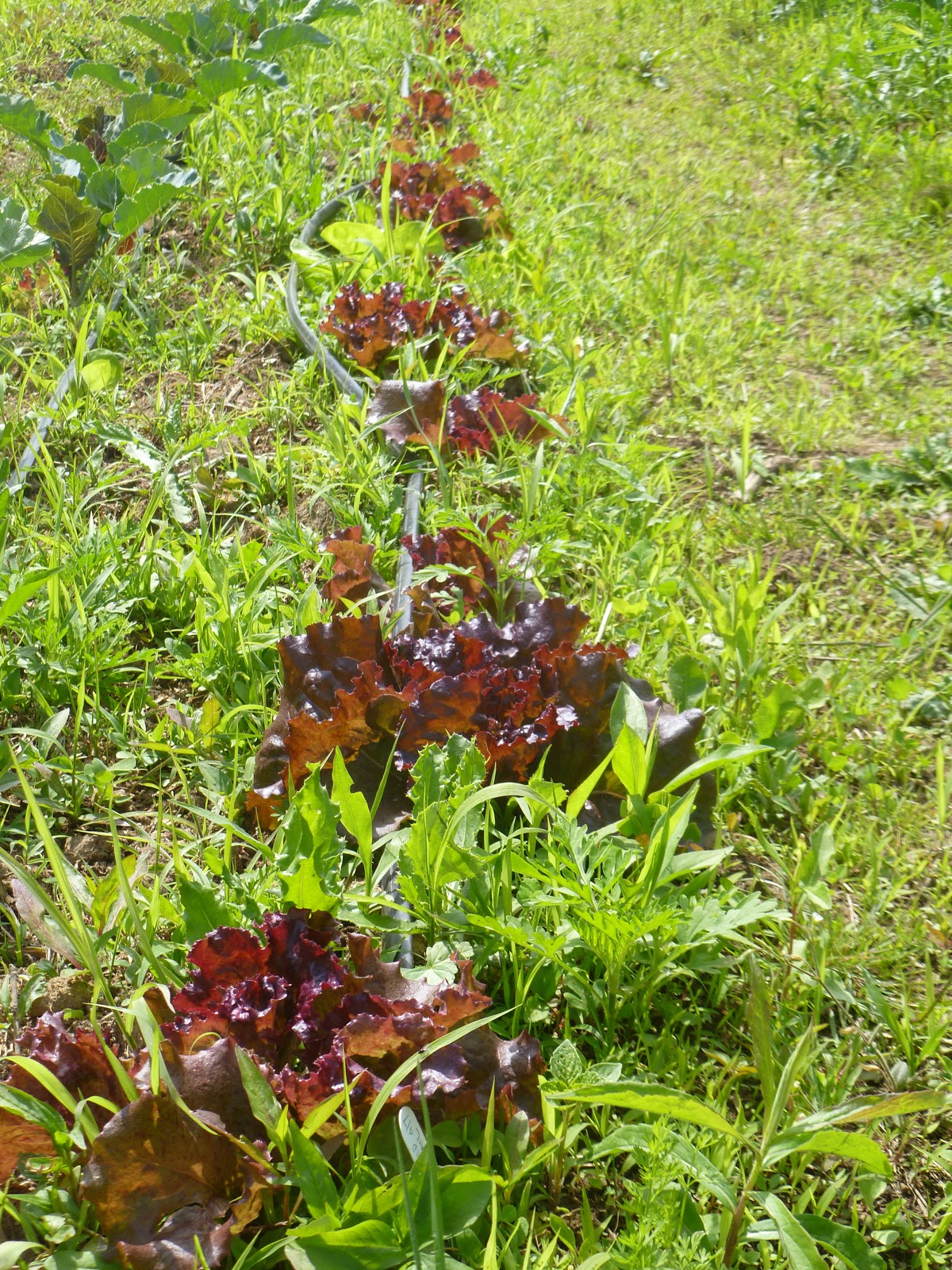
Broccoli and red leaf lettuce

Kale

Two rows of peas starting to climb the pea fence

Spinach

Purple Top turnips

Sunday, May 19, 2013

Hesperis matronalis and the Importance of Latin Names

Admiring a lovely bouquet of flowers at the farmers' market and remarking that they are one my favorite spring flowers, I was told by the vendor that they "loved Phlox too". I bit my tongue. 
The flowers were Hesperis matronalis, commonly known as Dame's Rocket. Well, after doing a quick internet search I found they also go by: Damask violet, Dame's violet, Dames-wort, Dame's gillifower, Night-scented gilliflower, Queen's gilliflower, Rogue's gilliflower, Summer lilac (though it blooms in spring), Sweet rocket, Mother-of-the-evening, and Winter gilliflower (again, it blooms in spring). And therein lies the problem. Common names can never be relied upon to specifically identify a plant unless of course the Latin names become the common names in cases such as Clematis, Phlox, Astrantia, etc. And it's a point I always stress when giving gardening talks. Reputable nurseries deal only in Latin names, because the scientific binomial naming system only gives each plant one name--one, no more. It's a beautiful system, but being in Latin (or Greek) it tends to scare off the lay gardener and hence the profusion of common names and resultant confusion over exactly which plant is which.
A riparian stand of Hesperis matronalis

Hesperis matronalis is not a native American wildflower, though one might easily mistake it for one as it's so widespread. It's originally from Europe and the name 'Hesperis' is Greek for evening as the flowers are most fragrant later in the day. They are reliably biennial but in mild climates can become half-hardy perennials. They cling to moist areas of the landscape, and preferring shade, usually bridge the gap between the open field and woodland habitats. As a garden flower they're quite fleeting lasting only a couple weeks before the show is over for the season. I especially like their soft colors and sweet fragrance. It's worth saving a shady corner for them.


Of course, they do look remarkably like upright garden Phlox (Phlox paniculata) or Phlox divaricata (Woodland phlox) but can be easily distinguished by counting the petals: Hesperis has 4, Phlox has 5. Hesperis also blooms a little earlier in the season so overlap is rare.

Monday, April 15, 2013

TGFG: Thank Goodness For Grass!

Yesterday was a big day in our farming calendar here at Terravita Farms. We anticipate it every year but with hay prices as high as $9.50 a square bale and $90.00 a round bale our favorite past time lately has been walking the pastures and watching the grass grow. Yesterday afternoon we decided the time had come and we spent the remaining daylight putting up the portable electric fences we use to keep the animals in, moving stock tanks for water, feed bowls, batteries, and various other things necessary for a move from haylot to pasture. When the time came the cows literally stampeded to their appointed square of grass--have you ever seen a bull kick up his heels? Stand back! The sheep didn't have to be asked twice, and the lambs, having only nibbled on bits of grass here and there in their winter lot didn't need any training on how to put their noses to ground and tear off mouthfuls of green goodness. 
This morning, when checking to make sure everyone was still where they were supposed to be after their first night in new surroundings, I was greeted by the following scenes. I'm sure if they could smile, they would all have been grinning wide!

**For best effect, click on the pictures to 'biggify'**
The Terravita Farms Randall herd--all 9 of them!

Lucien, the bull, leads the girls.
Guys always have to flex their muscles . . .

Last fall's 4 calves, "Hey, let's see who that is!"


"Hey, move over!"

"Would you tell her to move over?"

"Ok, I guess we have to yell!"

Mother and daughter, Jacob sheep.

Priscilla, Shetland ewe, "Wait a second, I need a scratch!"

Jasper, Shetland wether. "Yes, it's that good and it's all mine, mine!"

Sunday, April 14, 2013

68th Annual Granville Garden Club Daffodil Show

This weekend was the 68th Granville Daffodil Show, at Bryn Du Mansion, an event I always look forward to--even more so since Terravita Farms began growing daffodils for florists two years ago. My appreciation for and admiration of the daffodil continues to grow! 

Before I get to the pictures I'd like to share a happy coincidence that took place at the show. As I was getting ready to leave I decided I would wear a daffodil in the lapel of my jacket. I have quite a few daffodil bouquets in the house and was debating the strengths of the various flowers I had to choose from and finally settled on 'Accent'. I felt 'Accent' had something unique to offer as the clear white petals surround a trumpet that begins as yellow at the base, changes to gold near the middle, and finally ends in salmon, quite striking. The last room of the show has individual daffodils displayed in vases and each variety is available to pre-order as bulbs for fall planting. I noticed that one vase had a picture of the daffodil variety rather than a real flower--and that daffodil just happened to be 'Accent', the one in my lapel! I offered to give my flower to the show and it was quickly placed in the vase and exchanged with the picture--what a happy coincidence!

What follows, in no particular order, are a series of displays I found beautiful, interesting, and or eye-catching. Enjoy.